Our producers, our partners
In Japan, our teas are born between Shizuoka and Kagoshima, two regions cradled by mist and the sea.
It is there that the producers we collaborate with work—discreet, passionate artisans deeply attached to their land.
They know every tea plant, every plot.
Their expertise is not limited to cultivation: they also master the art of the blend, that delicate balance between nature and the human hand.
Thanks to them, our teas carry the signature of Japan: sincerity, harmony, and patience.

Spring – the awakening of young shoots
After winter, the tea plants slowly awaken.
Between April and May, the first harvest, known as ichibancha, yields the tenderest leaves, richest in umami.
Picked by hand or with small machines, they are immediately steamed to preserve their vibrant color and freshness.
Each cultivation method reveals a different personality:
- Sencha, bathed in sunlight, expresses a lively and slightly vegetal freshness.
- Kabusecha, partially shaded before harvest, develops a round, refined sweetness.
- Tencha, completely covered, will become matcha, with its silky texture and emerald color.
Thus, light and shadow shape the character of Japanese tea — an art of nuance and balance.

Summer and autumn – care, patience and blending
When the harvest ends, the fields rest.
Producers weed by hand, protect the roots, and nourish the soil without resorting to chemicals.
Summer is the season of quiet care.
In autumn, the leaves intended for hojicha are harvested and roasted, offering a warm and reassuring scent.
It is also the time when the art of the blend begins.
In Japan, this ancient tradition aims to balance the flavors of different plots and create a harmony that transcends the seasons.
Blending does not seek standardization, but an emotional consistency: rediscovering, year after year, the taste of a familiar moment.

Winter – the rest of the fields
In winter, the tea fields grow quiet.
Time seems to stand still, the leaves fold in, and the earth breathes.
This rest prepares for the vigor of the coming spring.
Everything in the tea cycle is a matter of rhythm and listening.

In France – the final stage of the trip
Once they arrive in France, all our teas pass through the hands of Nattie, founder and Japanese tea curator.
She personally oversees the final inspection of every batch: observation, infusion, and tasting.
Because tea is alive.
Even the same vintage changes slightly depending on the climate or the harvest.
These nuances, far from being a flaw, are a reflection of the passage of time.
Nattie tastes, compares, and chooses—so that every cup faithfully tells the story of the season it comes from.

The philosophy of packaging
Protecting the tea, but also evoking an emotion — that is our approach.
At TAMAKI TEA, function and beauty are inseparable.
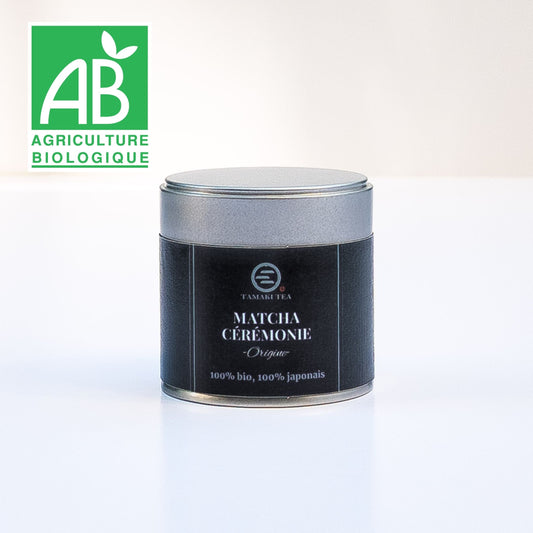
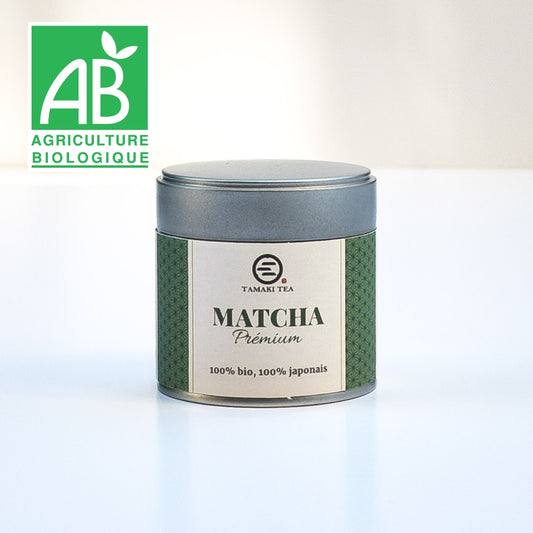
- Our Ceremonial Matcha and Premium Matcha are packaged in Japan in nitrogen-sealed tins to preserve the color and aroma of the freshly ground powder.
Upon opening, a bright green burst recalls the hills of Kirishima. - Our Senchas are packaged in France in double-lidded aluminum tins to ensure freshness down to the very last cup.
Their patterns are inspired by kachō fūgetsu — the beauty of flowers, birds, wind, and the moon.
Each tea has its own shade, its own poetry, its own season.
Opening a TAMAKI TEA tin is the first step of the tasting experience.

The shipment – a thoughtful touch for every cup
We prepare every order with the same care as a ritual.
Our packages are simple, elegant, and environmentally friendly: no unnecessary packaging, recyclable materials, and a design intended to protect without waste.
But above all, we always include a little surprise.
A hand-folded paper crane, a symbol of peace and gratitude.
A modest gesture to thank those who share our love of tea.

Green tea and you
The tea's journey ends at your home—on your table, in a moment of calm or sharing.
Matcha is savored during a meditative moment, or rediscovered as a creamy, modern, and comforting latte.
Sencha accompanies meals with grace: it cleanses the palate, elevates savory flavors, and pairs just as well with sushi as it does with a piece of aged cheese.
As for hojicha, it wraps evenings in a gentle warmth, perfect before sleep.
Drinking tea means reconnecting with slow time.
It means listening, breathing, feeling.
And in every sip, there is a little bit of Japan—and a great deal of humanity.
From the field to your cup,
TAMAKI TEA connects actions, seasons, and hearts.
We hope that each cup will offer you, if only for an instant,
the simple peace of a moment in harmony.
We recommend
-
CEREMONIAL MATCHA —Origin— ORGANIC
Regular price 35,00 €Regular price -
ORGANIC PREMIUM MATCHA
Regular price 29,00 €Regular price -
Organic HOJICHA powder
Regular price From 14,00 €Regular price -
ORGANIC FUKAMUSHI SENCHA
Regular price From 19,50 €Regular price