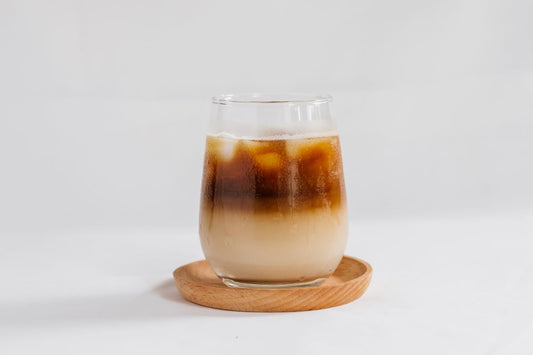
For a long time, a question has been nagging at me:
how much matcha should you actually use for the ideal latte?
There is no universal answer. It depends on many factors:
- the variety of matcha,
- the type of milk (plant-based or otherwise),
- whether or not to add sugar,
- whether the drink is hot or cold,
- and above all, your mood at the time.
Are you looking for a moment of focus? A little treat? A soothing break, or a decadent pairing with a pastry? Or perhaps just a matcha latte to enjoy on your own?
When you walk into a café, you rely on the barista to serve you the "best" matcha latte. But is this "best" really the one you’re looking for?
Taste, aroma, Instagram-friendly color... or profit margin? You don't know.
If you are a true matcha enthusiast, you might make your own latte at home. A little ritual that reflects your tastes.
And in this ritual: every gram counts, starting from the very first one.
"I always want to prepare the perfect matcha."
It is with this spirit that I launched this experiment.
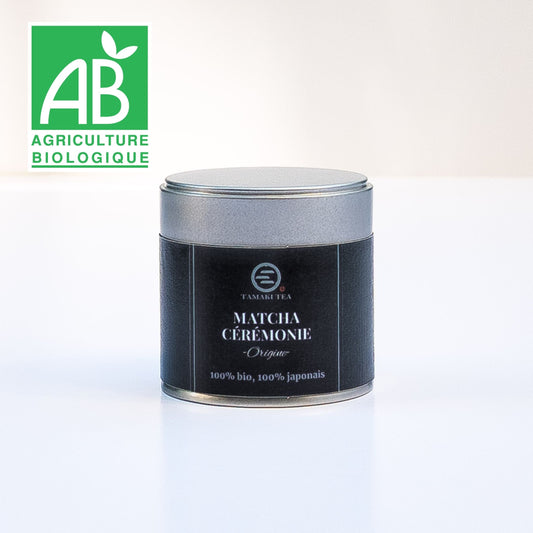
I used the CEREMONIAL MATCHA —Origin— ORGANIC with 120 ml of oat milk (unsweetened), and tested 1 g, 2 g, 3 g, and 4 g.
Experimental conditions
- Milk: 120 ml (oat, unsweetened)
- Hot water: 60 ml at 80 °C
- Whisking time: 30 seconds (chasen)
- Sugar: none — to be added if desired at the time of consumption
Test results


▶ 1 g![]()
Light matcha taste.
The sweetness of the milk dominates. The matcha is subtle.
For those who want a very mild latte, this is acceptable. But for a matcha lover, it may be too light.
▶ 2 g
The perfect balance between the natural sweetness of oat milk and the umami/subtle sweetness of the matcha.
Without added sugar, it is already satisfying.
Ideal for lovers who drink it without sugar.
▶ 3 g
The matcha taste becomes well-defined. Aroma, depth: it has it all.
With a little sugar, the combination is superb.
Recommended if you add sugar.
▶ 4 g
Highly concentrated. Even with a matcha that isn't very bitter (like our "CEREMONIAL MATCHA"), you start to feel some bitterness or harshness.
It’s not unpleasant: it’s rich. But for a latte, it might be too intense.
It is better enjoyed as a pure matcha with water than a traditional latte.

Summary of results
| Milk (120 ml) | Matcha | Characteristic | Recommendation |
|---|---|---|---|
| 120 ml | 1 g | Very light | Beginners |
| 120 ml | 2 g | Balanced umami & sweetness | No sugar |
| 120 ml | 3 g | Matcha clearly present | With sugar |
| 120 ml | 4 g | Very concentrated, bitter | To enjoy pure |
Calculation meter: "milk vs. matcha" ratio
As a Japanese person accustomed to the flavor of green tea, I found that for 120 ml of milk, 2 to 3 g of matcha was optimal.
Based on this, here is an equivalence table according to milk volume.
For a bold flavor (less sensitive to bitterness)
| Milk (ml) | Matcha (g) |
|---|---|
| 100 | 1.7 – 2.5 |
| 120 | 2 – 3 |
| 150 | 2.5 – 3.8 |
| 170 | 2.8 – 4.2 |
| 200 | 3.3 – 5 |
| 220 | 3.7 – 5.5 |
| 250 | 4.2 – 6.2 |
For a milder flavor (sensitive to bitterness)
| Milk (ml) | Matcha (g) |
|---|---|
| 100 | 1.3 – |
| 120 | 1.5 – |
| 150 | 1.9 – |
| 170 | 2.1 – |
| 200 | 2.5 – |
| 220 | 2.8 – |
| 250 | 3.1 – |
Conclusion

At the end of the day, there is no single right formula.
As I mentioned in the intro, you are the one who knows best the flavor you are looking for at that precise moment.
The type of matcha, the type of milk, the addition of sugar, the temperature, your mood at the time… everything influences the perfect cup.
That is why true pleasure lies in experimenting and finding your own balance.
And I will continue to explore and share these experiments for you:
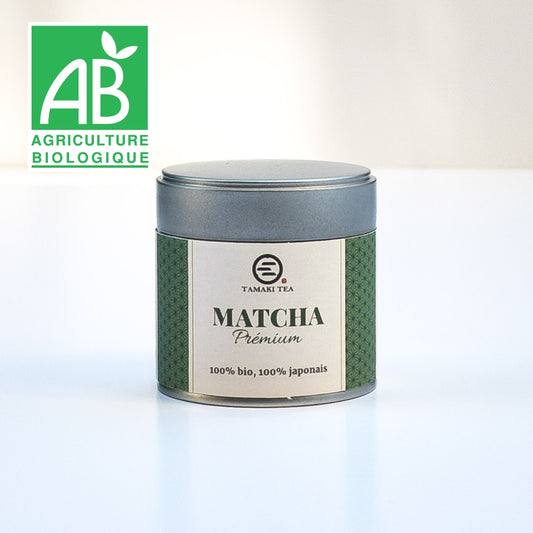
- other TAMAKI TEA matchas (e.g., HARMONY MATCHA, PREMIUM MATCHA)
- different types of milk (soy, cow, almond…)
- variations in temperature, with or without sugar, iced/hot options
Stay tuned: your perfect cup awaits.
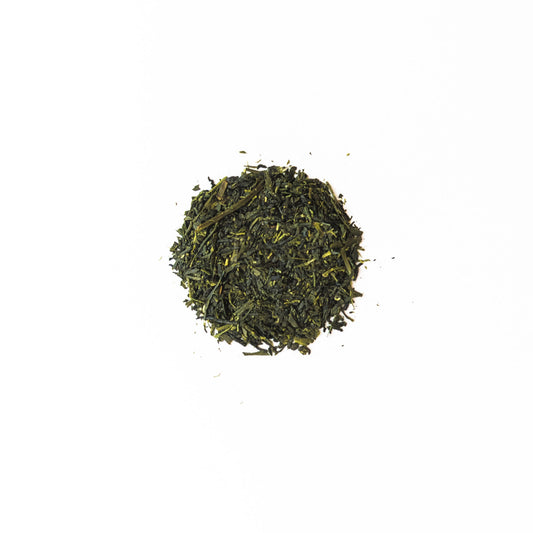
The matcha I used for this test.