Introduction
With the growing popularity of matcha worldwide, we see this word everywhere today: in supermarkets, cafés, and pastry shops.
But behind this name often lie products that have nothing to do with authentic Japanese matcha.
In this article, we explain why there is so much fake matcha, how to distinguish it from the real thing, and what criteria to look for to make the right choice.
Why is there so much fake matcha?
The term "matcha" has no strict legal definition at an international level.
The result:
- Tea leaves grown in full sun, simply ground, are sold as "matcha".
- Green tea powders of foreign origin (outside of Japan) also use this name.
- Their color is dull and their taste is bitter and astringent, yet they are marketed as "matcha" nonetheless.
👉 In short: just because a package bears the word "matcha" does not mean it is real Japanese matcha.
Real vs. fake matcha: the differences
| Characteristic | Real matcha | Fake matcha |
|---|---|---|
| Raw material | Tencha (shade-grown, specific to matcha) | Conventional green tea, grown in full sun |
| Production | Stone-ground (traditional method) | Powder obtained by simple mechanical grinding |
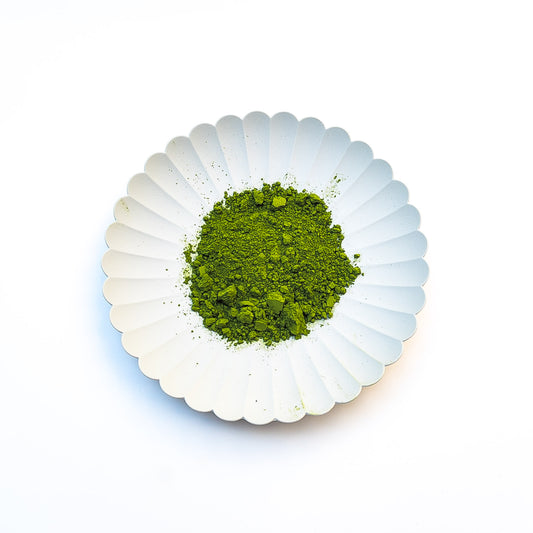
| Color | Vibrant, bright green | Dull to brownish green |
| Taste | Rich umami, sweetness, very little bitterness | Bitter, astringent |
| Whisked texture | Fine, creamy foam | No foam, separates quickly |
| Aroma | Fresh, mellow, slightly sweet | Grassy or nearly non-existent smell |
How to recognize real matcha?
- Color: a vibrant, luminous green.
- Label: check that the ingredient is indeed "tencha" and not a generic "green tea".
- Origin: the country of origin must be clearly indicated as Japan.
- Preparation: whisked with a chasen, it produces a fine, stable foam.
- Taste: round, umami, and slightly sweet, without excess bitterness.

👉 If these criteria are met, you have an authentic Japanese matcha.
The TAMAKI TEA commitment
At TAMAKI TEA, we offer only authentic matcha, crafted according to the traditional method:
- Shade-growing to enrich the leaves in umami.
- Processing into tencha, then stone-grinding to obtain a fine, silky powder.
- Packaged in Japan, under a nitrogen atmosphere, then shipped by air to France to preserve full freshness.
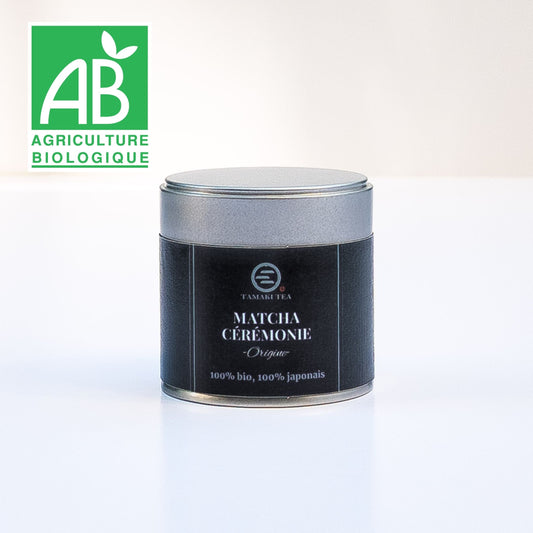
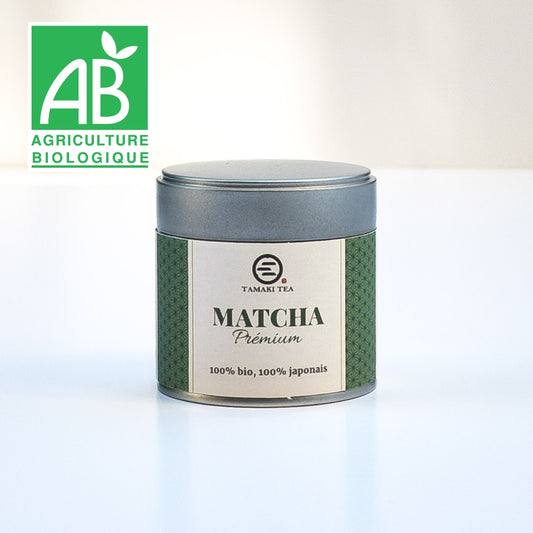
- Three ranges: Matcha Harmony (daily use), Matcha Premium (refined), Organic Ceremonial Matcha (ceremonial grade, for an exceptional experience).

Conclusion
The market is overflowing with products labeled "matcha" that are not truly so.
- Real matcha: tencha powder, shade-grown and stone-ground.
- Fake matcha: simple green tea powder, dull and bitter.
✨ For an authentic and healthy experience, choose genuine matcha.
Discover the TAMAKI TEA selection and savor a cup that embodies Japanese tradition.
For daily use → MATCHA HARMONY

For a more refined touch → ORGANIC MATCHA PREMIUM

For the tea ceremony → CEREMONIAL MATCHA —Origin— ORGANIC